Clive Rose/Getty Images
FIA wants to solve F1's compression ratio controversy prior to Australian GP
FIA single seater director Nikolas Tombazis says Formula 1’s governing body is trying to resolve the topic of compression ratio limits before the season-opening Australian Grand Prix.
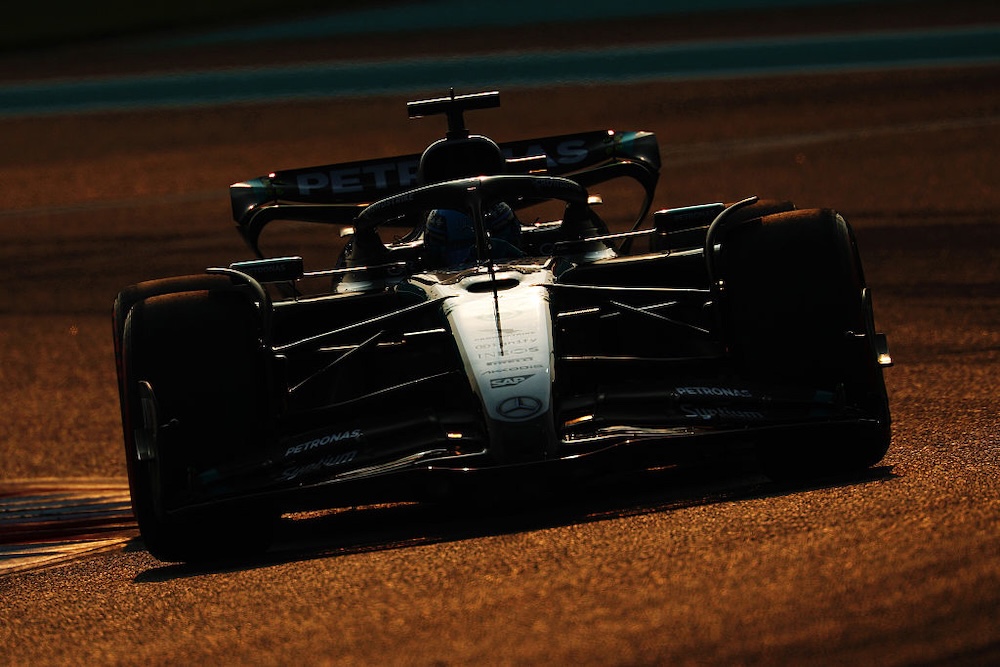
This year’s new power unit regulations restrict the compression ratio of the fuel/air mixture in the cylinder to 16:1, a reduction from 18:1 in previous years. Those limits are measured by the FIA at ambient temperatures, but Mercedes has faced questions over whether it has found a way to increase that ratio through cylinder head design when the power unit is running hot. Despite Mercedes boss Toto Wolff telling rivals to “get their s**t together”, the Tombazis says a resolution is being sought.
“It gets quite complicated to design those super-sophisticated engines with that number being very high,” Tombazis explained during an FIA video. “And of course, we wanted with these regulations early days to invite newcomers, and I think we've been quite successful.
“We have five PU manufacturers at the moment and one on the way of coming into sport. If we had not done those changes, I think we probably would have two by now – we’d have only two and that would have been a problem.
“So because all of these newcomers have started way behind the established ones, we had to create some ways that would enable these newcomers to join the sport on a fair playing field, because otherwise they would have been way behind, and as there's a cost cap, as there's limitations, they would have always been struggling to catch up.
“It's still going to be massively challenging for them; it's not an easy task. And that's why part of the condition for these guys to come in was also to create some simplification, some cost reduction also. And the compression ratio was one of those.
“That was one of the reasons we went from what used to be a limit of 18:1 - which frankly was almost not a limit because you could hardly reach that level - to 16:1, which is a bit of a compromise. And of course, as these engineers are very clever and always pushing for an advantage, some have found ways to potentially increase it when the engine is running hot. And that is the discussion we're having now.
"We've spent a lot of time with Jan [Monchaux, FIA single seater technical director] discussing how we solve those issues. And I think our intention is, of course, to solve them for the start of the season. We don't want to have controversies. We want people to be competing on the track and not in the courtroom or in the steward's room. And that's what we're trying to do.”
On Monday, McLaren Racing CEO Zak Brown dismissed any suggestion that Mercedes could be left in a position where it has designed a power unit that it is not allowed to run in Australia.
“It's typical politics of Formula 1,” Brown said. “The engine has been designed and [is] totally compliant within the rules. That's what the sport is about, no different than things like double diffusers that we've seen in the past where they're compliant within the rules.
“I don't believe that there's a significant advantage as being represented by the competition, but of course their job is any perceived advantage, they'll make a story out of it. But the reality is the engine is completely compliant, passed all its tests, and I think HPP [Mercedes High Performance Powertrains] has done a good job.
“We're aware, but it's a Mercedes topic. We obviously don't build and design the power unit, so HPP does a good job of keeping us in the loop. Obviously, we're very interested, but we don't sit in the power unit working group where those conversations happen.
“I can't imagine that you wouldn't have Mercedes teams on the grid in Australia. We're not privy to those conversations, so I wouldn't even know from a power unit point of view what would be required to change the regulations, but we'll have all the Mercedes teams on the grid in Australia, I'm sure.”

Chris Medland
While studying Sports Journalism at the University of Central Lancashire, Chris managed to talk his way into working at the British Grand Prix in 2008 and was retained for three years before joining ESPN F1 as Assistant Editor. After three further years at ESPN, a spell as F1 Editor at Crash Media Group was followed by the major task of launching F1i.com’s English-language website and running it as Editor. Present at every race since the start of 2014, he has continued building his freelance portfolio, working with international titles. As well as writing for RACER, his broadcast work includes television appearances on F1 TV and as a presenter and reporter on North America's live radio coverage on SiriusXM.
Read Chris Medland's articles
Latest News

Comments
Comments are disabled until you accept Social Networking Cookies. Update cookie preferences
If the dialog doesn't appear, ad-blockers are often the cause; try disabling yours or see our Social Features Support.